
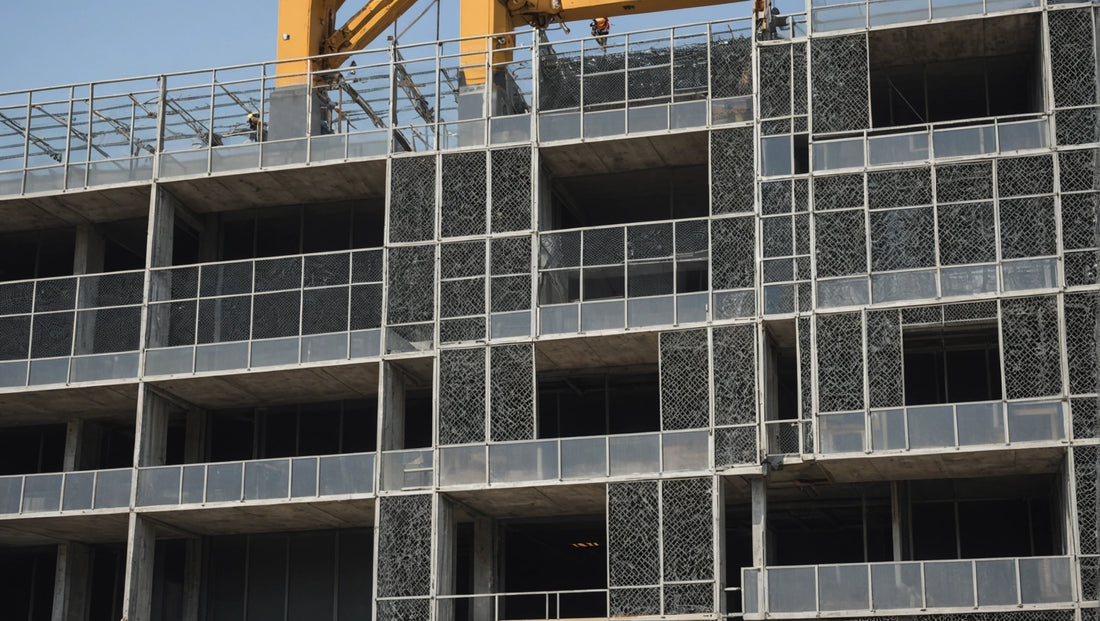
Welded mesh in modern architecture and house construction. Welded mesh as a key component for innovative house designs
In the world of construction, welded mesh has established itself as one of the key components. Its versatility and strength make it an indispensable element, especially in the construction of modern maison structures. But what exactly is welded mesh and why is it so important?
Definition and basic properties of welded mesh
Welded mesh are structured metal grids made from rods welded together. These rods are typically made of steel and are joined by the welding process to form a rigid mesh with square or rectangular patterns. Different steel grades and coatings enhance the adaptability of welded mesh to meet specific requirements in various construction projects. The main characteristics of welded mesh include their durability, stiffness and ability to distribute loads evenly. On construction sites they also allow for rapid laying and installation, which can significantly reduce construction time. This has a positive effect on the overall efficiency of a building project, as less time spent on installation means other phases of the project can start earlier. Here you can find our collection of different welded mesh products.
The role of welded meshes in modern architecture
Modern architecture is constantly seeking ways to combine aesthetic beauty with functional efficiency. Welded mesh offers enormous potential here. It can not only support loads, but its structure also enables the design of open, light-flooded spaces. This openness is achieved through the unique design of welded mesh, which allows architects to seamlessly link interior and exterior spaces.
The use of welded mesh in façades promotes natural daylight and contributes to the energy efficiency of buildings by reducing the need for artificial lighting. Here you can find our collection of various wire meshes. They offer durability and corrosion resistance for applications such as insect and nail protection, beekeeping and construction.
Innovations in Maison Construction
How welded mesh contributes to modern design
The aesthetic possibilities of welded meshes go far beyond their functional aspects. They allow architects to experiment with shapes and structures to create unique buildings that are both functional and visually striking. The variety of patterns that can be created with welded meshes opens up endless possibilities for creative designs. Whether in linear or more complex geometric patterns: using welded meshes makes it possible to create architecturally impressive projects that combine beauty and function.
The play of light and shadow on the lattice patterns creates a dynamic visual effect that is often sought after in today’s maison and residential projects. These effects can be intensified or softened by choosing different lattice spacings and patterns, depending on the desired impact and function of the space.
Examples of innovative building structures using welded mesh
From impressive facades to bold staircase designs, welded mesh can be found in a wide range of innovative structures. A particularly remarkable example is the “Grid House” in Amsterdam, which, with its open structure and use of welded mesh, stands out as a masterpiece of modern architecture. Other examples include public buildings such as universities and museums, which incorporate welded mesh as load‑bearing elements in their construction, thereby creating a modern, urban character.
Welded mesh is also frequently used in landscape architecture projects, where it serves as an organic extension of the natural environment while providing structural support. The flexible use of this mesh makes it possible to adapt it to different topographies, making it an excellent choice for outdoor projects.
Advantages of using welded mesh in construction
Stronger and safer structures thanks to welded mesh
The strength of welded mesh is unmatched, and its careful manufacture ensures that the structures in which it is used can withstand the loads placed on them. This durability is crucial for constructing safe buildings that stand the test of time. Especially in earthquake-prone regions, welded mesh can help reinforce buildings and ensure their structural integrity.
In addition, welded mesh provides extra protection in areas exposed to a high fire risk thanks to its high temperature resistance. Its fire-resistant properties can be further enhanced with suitable coatings to meet safety requirements.
Cost efficiency and economic benefits of using welded meshes
Welded mesh contributes to the cost efficiency of construction projects. Thanks to their light and quick installation, labor time and therefore costs are reduced. Material usage is also optimized, which in turn leads to a better economic balance. Their standard sizes and modular designs simplify planning and procurement, supporting standardized construction methods and drastically reducing lead times.
In addition to saving time and costs, welded wire is also environmentally friendly, as its use can reduce the amount of concrete needed. Less concrete means fewer CO2 emissions, which in turn minimizes the ecological footprint of a construction project.
Areas of use and possible applications
Typical applications of welded mesh in building construction
From car parks to residential buildings and bridges—welded mesh is a reliable companion in a wide variety of construction projects. It is frequently used in stairwells, as wall cladding and even as architectural artworks. Every year, architects discover new applications for welded mesh, as its adaptability is almost unrivalled.
- Reinforcement of concrete structures
- Facade design
- Use in floors and ceilings
- Protective and security fences
In interior design, welded mesh is also used, whether in open, slender shelving systems or in partition walls that divide the space without making it feel smaller.
Expanded application fields through new technologies and materials
With advances in technology and materials science, more and more applications for welded mesh are emerging. New coating processes and materials significantly expand their range of uses, whether in aggressive environments or as decorative elements. Especially in the field of corrosion-resistant materials, such as galvanized steel or refined steel with special alloys, welded mesh offers advantages in hygiene-critical environments such as hospitals and laboratories.
Combining welded meshes with other materials such as glass or wood enables unique blends of modern and traditional design that are used in numerous architectural projects. These hybrid construction methods offer not only aesthetic variety but also additional functional benefits such as improved acoustics or insulation.
Challenges and solution approaches
Potential problems in the use of welded mesh
When using welded mesh, challenges can arise, such as susceptibility to corrosion or the need for precise planning and installation. In addition, the site conditions must be handled carefully to avoid potential material stresses. Choosing the right locations for welded mesh requires knowledge of the load limits of the selected materials and their ability to adapt to different climatic conditions.
Strategies for optimizing welded‑mesh constructions
A strategic approach can help overcome these challenges. This includes robust corrosion protection methods, regular maintenance and the integration of welded meshes into the overall architectural design. Thanks to BIM technologies (Building Information Modeling), planning processes can be further optimized. By using 3D modelling and digital simulations, the best locations for installation can be determined and potential structural problems identified and resolved in advance.
Future prospects for welded mesh in architecture
Future developments and trends in the use of welded wire mesh
Technological developments are opening new doors for welded mesh in architecture. From the integration of intelligent sensors to the realisation of complex geodesic domes – the possibilities are almost limitless. Welded mesh is expected to be used increasingly in modern, sustainable buildings. In combination with advanced energy management systems, such as integrated solar modules, these structures could make existing and new buildings particularly environmentally friendly.
Environmentally friendly and sustainable approaches in welded mesh technology
Sustainability is an important topic in contemporary architecture. Welded mesh offers advantages here in terms of recyclability and reusability of materials. Advances in manufacturing and recyclable steel grades contribute to a significant reduction in the ecological footprint. Through targeted measures and smart material choices, construction projects can be realized that comply with the principles of a circular economy.
Using recycled steel in the production of welded mesh not only reduces material costs, it also protects the environment by lowering energy consumption in steel production. This leads to a reduction in carbon emissions and supports global climate protection efforts.
If you are looking for a reliable partner for your construction projects who combines quality and innovation, put your trust in Metal Market for your welded mesh.